Thursday, March 24, 2011

Connection Across Time

Information from World War I that is pertinent to today would be how the war is still affecting countries today.  Countries such as Iraq, Israel and the Palestinians, Russia, Turkey and Vietnam are all still dealing with the impact left behind of World War I.  For instance, the cause of war in Iraq today could be traced all the way back to World War I. What I can learn from these lessons, as well as the rest of the world, is that every decision or choice made will always have a consequence that could never go away and that could affect more people than imagined for generations, whether those consequences are good or not is all up to the decision made.

World War I


War in Iraq today

2 US events that occured during this time period

Seventeenth Amendment to the US Constitution

The Seventeenth Amendment to the US Constitution was adopted on April 8, 1913.  The Amendment established direct election of United States Senators by popular vote.  Before this amendment, Senators were elected by State Legislatures.  It also alters the procedure for filling vacancies in the Senate, to be consistent with the method of election.  A connection across continents would be how in Europe, there were still empires, such as the Ottoman Empire, and they did not have this form of democratic government.  It shows how our form of government works well for our country but may not for other countries in Europe.  To me, it also seems as though we are more advanced and organized when it comes to our government because Russia for example, is just now having their revolution and modernizing.


First Woman Elected to US Congress

The first woman elected to US Congress was in 1916.  Her name was Jeannette Rankin and she was elected in the state of Montana.  She is also the only woman to have been elected from the state of Montana.  She was a lifelong pacifist and voted against the entry of the United States into World War I.  A connection across continents would be how in Europe, during the war, women had to step up and start to work more.  Women were working as doctors and nurses as well as in factories.  Women were starting to make progress in both the United States and in Europe.


Spotlight On...

Problems Caused by The Treaty of Versailles

Germany thought that the Treaty of Versailles was harsh.  They did not take it well and it caused outrage and anger throughout Germany.  In the end, it seems as though the treaty that was made to help bring peace throughout the world only caused the foundations for another world war.  Germany went through a huge economic crisis and experienced a lot of unemployment issues.  All of this caused a lot of built up anger and hatred toward the people who created this treaty.  The Germans were upset that they were blamed for starting World War I and they did not think that they should have been to blame.  We see a rise of a new leader during this time as well.  Hitler starts to voice his opinion more and gains many followers.  He was motivated to get back at the creators of the treaty and to retaliate and becuase of his motivation, along with the motivation of other great leaders, Germans began to become very angry and wanting to take action.  All of these issues start to lay the foundation for another world war so in the end, the Treaty of Versailes ended up doing more harm than good. 


(Big Four from the meeting at Versailles)

3 Works of Art

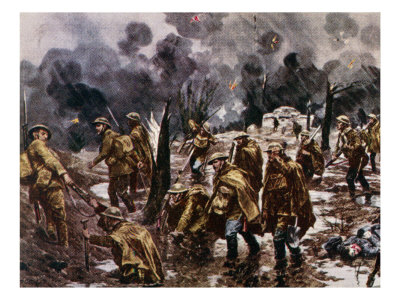
Artist: William Hole

This piece of art is of soldiers in mud near Ypres in Belgium during World War I.  I liked it because it shows the trenches that were used during the war and how there were just dead bodies lying there.  I like in the bottom left hand corner how the man is helping pull the other man out of the trench.  It shows how they all worked together.  It also shows how deep these trenches were in some areas.  With all of the diseases caught from being in those trenches as well as the bad weather it shows in this picture, the picture goes to show how bad the conditions were during this war.

Artist: John Nash

I liked this piece of art for similar reasons as the last piece of art.  It really portrays the harsh conditions the soldiers had to deal with and what the trench warfare style of fighting looked like.  There were soldiers lying dead and garbage and such lying there as well.  The weather was harsh too. 


Artist: John Singer Sargent

I liked this piece of art because it is displaying the affects of mustard gas.  Mustard Gas was used during the war for the first time and is significant to the war.  I like how the artist made everything in the picture yellow, like mustard and how there are people lying dead all over the place.  It looks like there are two separate groups in the picture.  One could be the Allied Powers and the other the Central Powers. 

Three People Important To This Time Period

Archduke Francis Ferdinand

Archduke Francis Ferdinand was an important person to this time period because his assassination was a cause for the beginning of World War I.  His assassination shows how nationalism was so large at that time and that nationalism at its extreme is why this world war started. Ferdinand symbolizes the start of World War I and nationalism so therefor he was an important person of that time period.


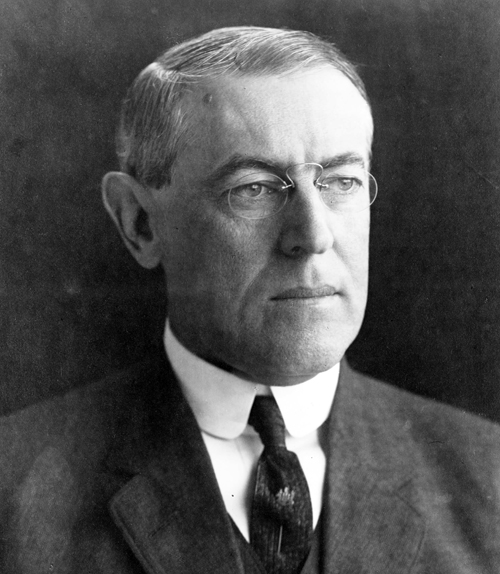
President Woodrow Wilson

President Woodrow Wilson was an important person to this time period because he had good intentions during the war and he waited until the right time to enter the United States in the war.  Wilson had a large impact on the Treaty of Versailles becuase of his idealistic views and his goal to achieve lasting peace, also known as his Fourteen Points.  He was one of the Big Four that were at the meeting at Versailles and responsible for helping to write this treaty.  


Marshal Ferdinand Foch

Marshal Ferdinand Foch was an important person to this time period because he was the supreme commander of the Allied Armies and general in the French Army.  He stopped the advance of the German forces during the great push of Spring 1918 at the Second Battle of Marne in July 1918, and made the counter-attack that turned the tide of the war. Marshal Foch also had a major role at the Paris Peace Conference.


Chapter 27:World War I

Introduction:

On June 28, 1914, Archduke Franz Ferdinand was assassinated and that, along with the increase in nationalism, launched the world into World War I.  The War began in the beginning of August of 1914.  The war caused many deaths, a lot of destruction and even revolutions, such as the Russian Revolution.  There were two major sides of World War I, the Allied Power, which contained mainly France, Russia and Great Britain, and then the Central Powers, containing mainly Germany and Austria-Hungary.  The Allied Powers also gained support of Serbia, Italy, Romania, Greece, the United States and Japan.  The Central powers won support of Bulgaria and the Ottoman Empire.  Germany had used the Schlieffen Plan as a strategy to win the war but it had only failed them.  This war introduced new ways of fighting, such as trench warfare, new weapons, like  machine guns, airplanes and poison gas, and submarine warfare.  In 1918, the Germans were forced to retreat and the fighting ended with the signing of an armistice in November 1918.  Then, on June 28, 1919 the Treaty of Versailles was signed putting all of the blame on Germany for the cause of World War I.  The Treaty of Versailles will cause many issues and will be the foundation for the start of a second world war.


Chapter/Unit Objectives:

1.) What were causes of the war?
2.) The war led to revolutions and the fall of empires.
3.) The new ways of fighting that were introduced in World War I.
4.) The impact the Treaty of Versailles had on Germany.
5.) The ways in which World War I still affects the world today.


Essential Question:

What does "The lamps are going out all over Europe; we shall not see them lit again in our lifetime" mean?


Answer!!

It is a sense of hoplessness and resembles how things will not be the same in the world, especially Europe, for a very long time.